5G technology is reshaping the smartphone landscape in remarkable ways. You can expect lightning-fast speeds and seamless connectivity that enhance your daily mobile experience. With 5G, you enjoy download speeds up to 20 Gbps, compared to just 1 Gbps with 4G. This leap in technology allows you to stream videos and play games without interruption. As of 2021, over 40% of global smartphone shipments are expected to be 5G devices, a number projected to rise to 69% by 2025. The future of mobile communication looks brighter than ever.
Feature | 5G | 4G |
|---|---|---|
Peak download speed | 20 Gbps | 1 Gbps |
Peak upload speed | 10 Gbps | 0.2 Gbps |
Latency (shortest delay time) | 1 millisecond | 10 milliseconds |
Availability | 99.999% | 99.99% |
Mobility | 500 km/h | 350 km/h |
Positioning accuracy | 1 meter | 45 meters |
Device density (per square mile) | 2.5 million | 250 |
5G Features
Speed and Latency
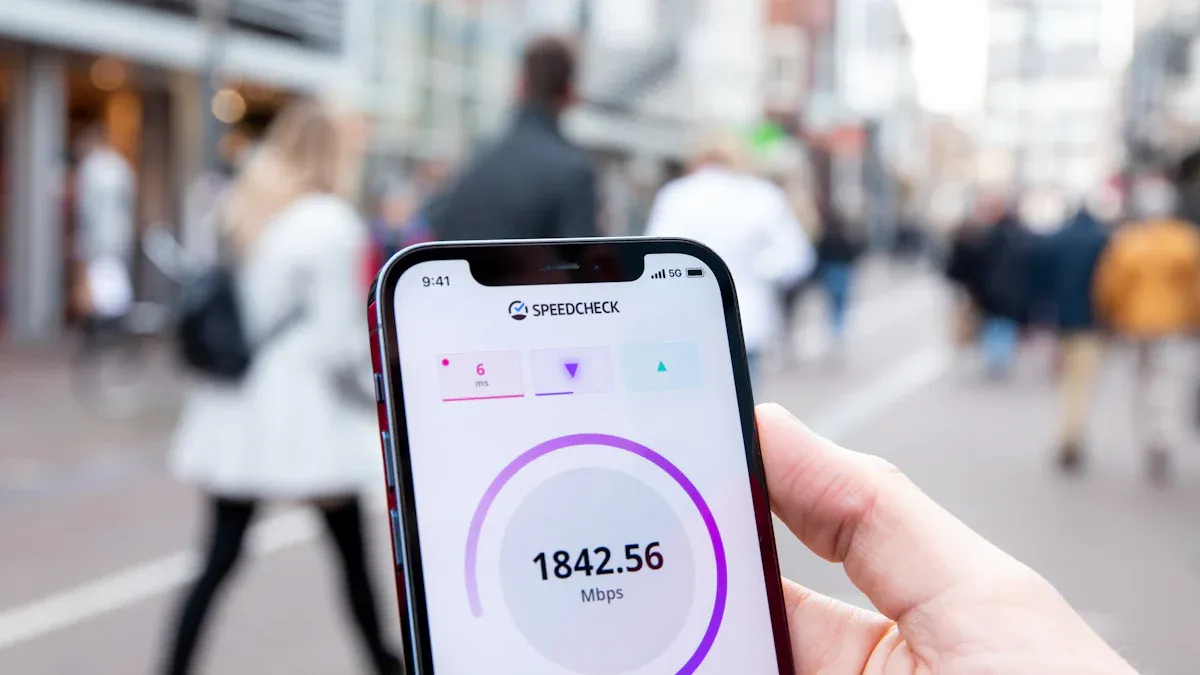
5G technology offers remarkable speed and ultra-low latency, transforming how you use your smartphone. With 5G, you experience download speeds ranging from 100 to 400 Mbps, compared to 20 to 50 Mbps with 4G. This increase in speed allows you to download large files in seconds.
The latency of 5G networks is significantly lower than that of 4G. While 4G latency ranges from 30 to 60 milliseconds, 5G reduces this to just 1 to 10 milliseconds. This improvement is crucial for applications that require real-time responses, such as gaming and video conferencing.
Here’s a quick comparison of latency:
Network | Latency (ms) |
|---|---|
4G | 30 – 60 |
5G | 1 – 10 |
The reduced latency enhances your experience with applications that demand immediate feedback. For instance, in online gaming, you can react faster, giving you a competitive edge. In video calls, you enjoy smoother conversations without annoying delays.
Connectivity and Efficiency
5G networks provide greater bandwidth and improved connectivity, allowing more devices to connect simultaneously without sacrificing quality. This feature is essential as the number of connected devices continues to rise.
5G employs advanced technologies like massive MIMO (Multiple Input Multiple Output) and beamforming. These innovations enhance signal efficiency and coverage, especially in crowded areas. Here are some key aspects of 5G connectivity:
Sub-6 GHz and mmWave: These frequency bands improve coverage and bandwidth, crucial for urban environments.
Small Cell Networks: These compact base stations enhance localized capacity, ensuring you stay connected even in high-demand areas.
Network Slicing: This technique allows the creation of tailored virtual networks for different applications, optimizing performance.
5G also focuses on energy efficiency. It uses intelligent algorithms to manage power levels based on traffic demand, reducing energy consumption. This means your smartphone can maintain high-speed connectivity without draining the battery quickly.
User Experience with 5G
Gaming and Streaming
5G technology significantly enhances your gaming and streaming experiences. With ultra-low latency and high-speed networks, you can enjoy seamless gameplay and uninterrupted video streaming. Here are some key improvements you can expect:
Reduced Latency: 5G can achieve loopback latency as low as 2 milliseconds. In contrast, 4G averages around 50 milliseconds. This reduction means you can react faster in games, giving you a competitive edge.
Seamless Gameplay: The technology virtually eliminates lag, ensuring smooth and uninterrupted gaming sessions. You can engage in fast-paced games without worrying about delays.
Enhanced Real-time Feedback: Improved bandwidth allows for instantaneous actions and reactions in games. This feature is crucial for competitive gaming scenarios.
Increased Accessibility: Robust connectivity enables participation in e-sports from remote areas, breaking down geographical barriers.
Here’s a quick overview of the improvements in mobile gaming performance due to 5G networks:
Improvement Aspect | Description |
|---|---|
Reduced Latency | 5G can achieve loopback latency as low as 2ms, significantly lower than the 20ms of 4G. |
Seamless Gameplay | The technology virtually eliminates lag, ensuring smooth and uninterrupted gaming sessions. |
Enhanced Real-time Feedback | Improved bandwidth allows for instantaneous actions and reactions in games. |
Increased Accessibility | Robust connectivity enables participation in e-sports from remote areas. |
When it comes to streaming, 5G technology transforms your viewing experience. You can enjoy high-definition (HD), ultra-high-definition (UHD), and even 8K video without buffering. Here are some benefits of 5G for streaming:
5G provides ultra-low latency, high bandwidth, and massive device connectivity.
These features eliminate friction points in video streaming, enhancing your overall experience.
You can stream high-quality video simultaneously with multiple users without performance issues.
Augmented Reality
5G technology also revolutionizes augmented reality (AR) applications on smartphones. The low latency and high-speed connectivity enhance the responsiveness and realism of AR experiences. Here are some notable impacts of 5G on AR:
Virtual Try-ons: You can virtually wear clothes and accessories, enhancing your shopping experience.
Interactive Product Information: Instant access to product details through AR improves your shopping efficiency.
Virtual Store Navigation: AR can guide you through large stores, helping you find products easily.
Virtual Furniture Placement: Companies like Ikea allow you to visualize how furniture fits in your home.
The benefits of 5G for AR applications include:
5G provides low latency, resulting in minimal delay between your actions and system responses.
This low latency, combined with high-speed connectivity, enhances the responsiveness of AR applications.
You experience real-time interactions without lag or buffering, making the AR experience more immersive and realistic.
Overall, 5G technology significantly improves your user experience in gaming, streaming, and augmented reality. As the telecom industry continues to evolve, you can expect even more innovative applications that leverage these advancements.
5G Applications in the Industry
New Business Models
5G technology opens the door to innovative business models in the smartphone industry. You can see how companies adapt to the new landscape. Here are some emerging business models:
Business Model Type | Description |
|---|---|
MVNO Specialization | Mobile Virtual Network Operators (MVNOs) can focus on specific customer segments with optimized service levels, leveraging 5G’s network slicing capabilities. |
Fixed Wireless Access (FWA) | This model provides an alternative to traditional fiber, especially in hard-to-reach areas. It allows MVNOs to offer bundled services for remote workers. |
Temporary High-Value Subscriptions | New dynamic for short-term subscriptions tailored for specific needs, enhancing service flexibility. |
These models reflect the impact of 5G on business strategies. Companies can now create tailored services that meet specific consumer demands.
Manufacturer Competition
The introduction of 5G technology intensifies competition among smartphone manufacturers. You can expect to see various strategies as companies strive to differentiate their 5G-enabled devices. Here are some key strategies:
Strategy Type | Description |
|---|---|
Innovation | Manufacturers introduce innovative product features to stand out in the competitive market. |
Strategic Partnerships | Companies form partnerships to enhance their market presence and product offerings. |
Aggressive Marketing | Brands employ aggressive marketing tactics to capture consumer attention and drive sales. |
Additionally, manufacturers are increasing investments in research and development to improve 5G capabilities. This trend indicates a strong growth trajectory in the 5G smartphone market. Competitive pricing strategies also play a role, as the decreasing cost of 5G chipsets contributes to overall market growth.
As the telecom industry evolves, you will see how these new business models and competitive strategies shape the future of smartphones. The impact of 5G technology is profound, driving innovation and creating better bandwidth for users.
5G technology is set to transform your smartphone experience significantly. As more devices adopt 5G, you can expect faster speeds and improved connectivity. In fact, the percentage of smartphones with 5G capability rose from 56% in 2021 to 77% in 2023. This shift influences how you interact with mobile applications, especially in gaming and streaming.